How LLMs Are Actually Trained: From Knobs to Reasoning

Large language models can write code, summarize research, solve complex math problems, and hold natural conversations. That makes them feel like magic. Yet the training process behind them is surprisingly mechanical: it is a loop of guessing the next word, measuring the error, and turning billions of tiny numerical knobs. An LLM is not taught facts the way a human student is taught in school. Instead, it is trained to predict what word comes next, refined to behave like a helpful assistant, and finally coached through trial-and-error practice to verify and improve its own reasoning.
Step-by-Step Guide
- Identify which layer fits your problem: use Retrieval-Augmented Generation (RAG) for private facts, Supervised Fine-Tuning (SFT) for consistent tone or formatting, and RL/GRPO for verifiable multi-step reasoning.
- Spin up a free Google Colab notebook with a small open-weights model like Qwen 0.5B and compare the base model against the instruct model on the same prompt.
- When building custom SFT datasets, format every example with consistent User and Assistant markers and ensure every response ends with a stop token.
- For math, logic, or code tasks where correctness can be checked automatically, use GRPO to sample multiple candidate solutions per prompt and reinforce answers that score above the group average.
- Always build an evaluation benchmark before training so you can measure whether fine-tuning actually improves performance over simple prompting.
Introduction: Why LLM Training Feels Like Magic (And Why It Isn't)
When you watch a modern language model debug software or walk through a multi-step math problem, it is easy to assume the system thinks like a person. Under the hood, however, the process is grounded in straightforward engineering. Every capability emerges from three distinct training stages:
- Pre-training: Building a giant autocomplete engine by predicting the next word across massive amounts of text.
- Post-training (Supervised Fine-Tuning): Turning that autocomplete engine into a polite, instruction-following assistant that knows when to stop talking.
- Reinforcement Learning: Teaching the model to practice, score its own candidate answers, and strengthen its step-by-step reasoning.
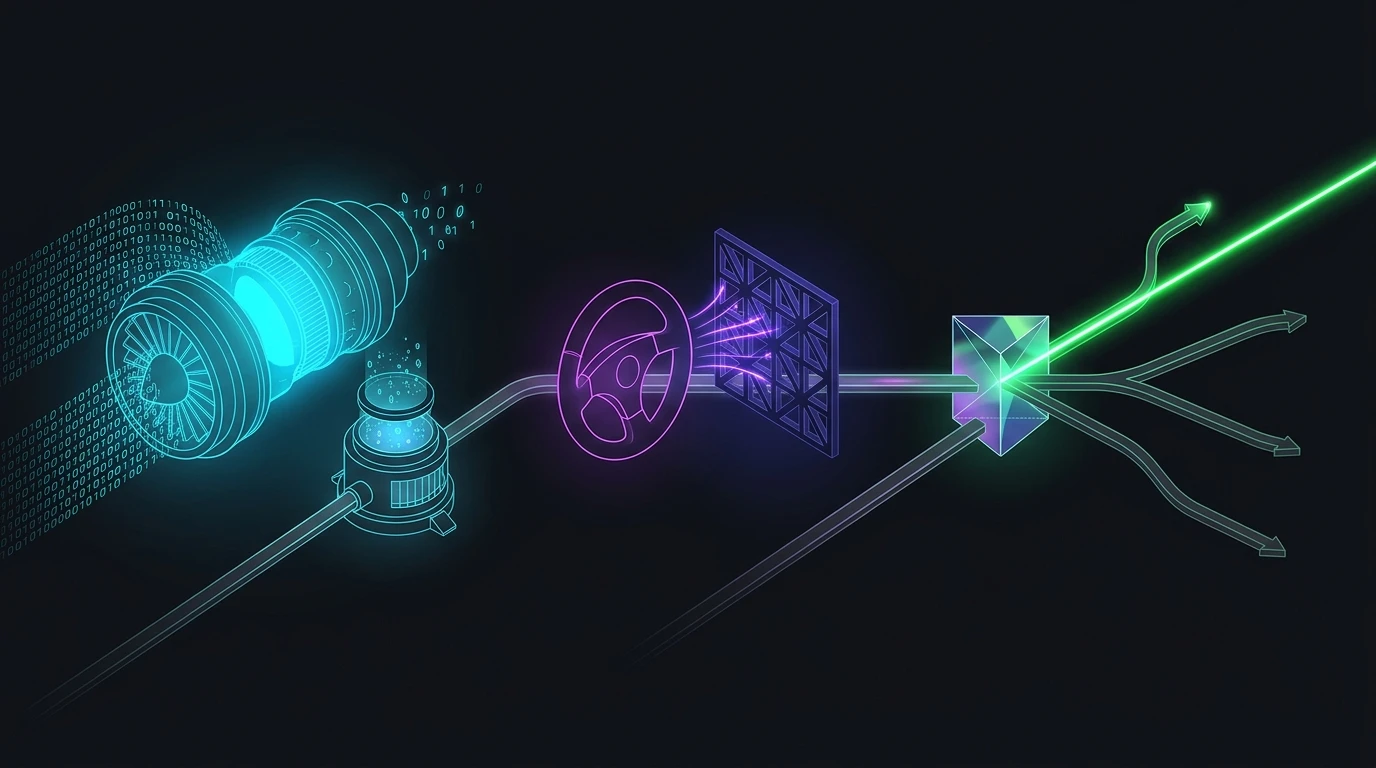
In the sections below, we will walk through the mixing-board mental model, test an interactive parameter-tuning simulator directly on this page, examine why these three training stages are kept separate, and look at how builders can experiment with open-weights models at home.
Part 1: The Mental Model: An LLM Is a Giant Mixing Board
A helpful way to picture a large language model is to imagine a massive audio mixing board in a recording studio, stretching across a room with billions or even trillions of rotary knobs.
- The knobs are the model's parameters (weights): When people refer to a 70-billion or 2-trillion-parameter model, they mean there are 2 trillion adjustable numbers inside the network. At the start of training, every knob is set to a random value.
- The sound check is the loss function: The model makes a prediction, compares it to the actual target word, and calculates a single error score called the loss. A high loss means the prediction was far off; a loss near zero means the prediction was spot on.
- The auto-engineer is backpropagation: Because no human could tune trillions of knobs by hand, frameworks like PyTorch use an algorithm called backpropagation. It calculates how much each individual knob contributed to the error and determines which direction to nudge it.
- The step size is the learning rate: The learning rate controls how far each knob is turned during an update. If the step size is too large, the model overshoots the best setting; if it is too small, learning takes too long.
Input Text → Parameter Knobs"] --> B["2. Prediction
Next-Token Probabilities"] B --> C["3. Sound Check (Loss)
Measure Error vs. Target"] C --> D["4. Backpropagation
Compute Direction for Each Knob"] D --> E["5. Gradient Descent
Nudge Knobs by Learning Rate"] E -.->|"Repeat Millions of Times"| A style A fill:#0f172a,stroke:#38bdf8,stroke-width:2px,color:#fff style B fill:#1e1b4b,stroke:#818cf8,stroke-width:2px,color:#fff style C fill:#3b0764,stroke:#c084fc,stroke-width:2px,color:#fff style D fill:#450a0a,stroke:#f87171,stroke-width:2px,color:#fff style E fill:#064e3b,stroke:#34d399,stroke-width:2px,color:#fff
This core training loop (make a prediction, compare it to the target, calculate the loss, run backpropagation, and nudge every parameter) is the foundation of modern deep learning. The rest of LLM training comes down to what target you use and how you score the model's output.
| Term | Mixing Board Analogy | Plain-English Meaning |
|---|---|---|
| Parameter / Weight | A single rotary dial on the mixing console | An adjustable number inside the neural network that scales signals passing through it. |
| Loss Function | The studio sound-check error meter | A mathematical score measuring how wrong the model's prediction was compared to the target. |
| Gradient | The arrow showing which way to turn a knob | The exact direction and sensitivity indicating how a parameter change affects the loss. |
| Backpropagation | The automated sound engineer | The algorithm that works backward from the error to compute gradients for every parameter at once. |
| Learning Rate | How far the engineer turns each knob per step | A setting that controls how large each parameter update is during training. |
| Gradient Descent | Iteratively tuning until the sound is clear | The process of repeatedly stepping downhill on the loss score across millions of examples. |
Try It Yourself: Interactive Mixing Board & GRPO Simulator
Use the interactive workbench below to see how parameter tuning works in practice. In Tab 1, drag the four parameter knobs yourself or click Run 1 Backprop Step to watch the auto-engineer increase the probability of "Paris" while driving the loss score down. Then explore Tab 2 and Tab 3 to compare Base, SFT, and RL outputs and see how GRPO scores groups of candidate answers.
LLM Mixing Board & GRPO Training Simulator
Turn the model’s parameter knobs manually or run a backpropagation step to see how pre-training, instruction tuning, and GRPO reinforcement learning adjust probabilities.
Loss = -ln(Probability of "Paris") (0.000 = Perfect)Advantage = (Reward - Group Average) / Spread.Part 2: From Text to Tokens: What the Model Actually Sees
Before training begins, raw text is broken into smaller pieces called tokens. A token can be a whole word, a word fragment, or a single character. Every token in the model's vocabulary is assigned an ID number and converted into a list of numbers (a vector embedding).
The model processes those vectors through a Transformer architecture, which uses a mechanism called self-attention to weigh which words in the sentence relate most strongly to one another. For instance, when reading the phrase "The capital of France is", self-attention connects the words "capital" and "France" so the network focuses on French cities.
During the first stage of training, the objective is straightforward next-token prediction:
Given a sequence of words, predict the most likely word or token that comes next.
On the surface, that sounds like simple phone keyboard autocomplete. However, predicting the next token accurately across trillions of words of books, articles, and source code forces the model to learn grammar, factual associations, writing styles, and reasoning patterns. It also explains why a raw model can feel both brilliant and unreliable: it has learned what usually comes next in text, not what is objectively true.
Part 3: Pre-Training: The World's Most Sophisticated Autocomplete
Pre-training is the first and most expensive phase of building an LLM. The network is trained on massive text collections (web pages, books, academic papers, and code) using next-token prediction.
The Pre-Training Loop in Plain English
- Feed the model a sequence of text from a document.
- Hide the very next token in the sentence.
- Ask the model to assign probabilities to what that hidden token should be.
- Compare the model's prediction to the real token using cross-entropy loss.
- Run backpropagation to calculate how each parameter contributed to the mistake.
- Nudge the parameters slightly in the right direction and repeat across terabytes of data.
What a Raw Base Model Is Like
At the end of pre-training, you get a base model. A base model is pure autocomplete. It is not trying to be helpful, polite, truthful, or safe. If you prompt a base model with an incomplete sentence like "In his keynote speech, the researcher said...", it will happily invent a quote out of thin air. It is not lying; it is doing exactly what it was trained to do by guessing what words typically follow that pattern.
| What Pre-Training Gives the Model ✅ | What Pre-Training Does NOT Give the Model ❌ |
|---|---|
| Fluency across human and programming languages | A helpful conversational assistant persona |
| Broad world knowledge and domain vocabulary | Reliable instruction-following behavior |
| Style, tone, and structural writing patterns | A built-in commitment to truthfulness over guessing |
| Foundational code and math pattern recognition | Safety alignment or boundaries |
| A strong base for later fine-tuning | The ability to stop talking at the right time or verify multi-step logic |
Part 4: Post-Training: Turning Autocomplete into an Assistant
A raw base model is frustrating to use in conversation. If you ask it a question, it might reply with three more questions because it thinks it is autocompleting a test worksheet. Researchers solved this with a simple formatting trick: structure the training text as a back-and-forth dialogue between a User and an Assistant, and let the model autocomplete the assistant's turn.
User: What is the capital of France?
Assistant: The capital of France is Paris. <|im_end|>
When you train a base model on thousands of curated examples like this, it learns to adopt an assistant persona. This stage is called Supervised Fine-Tuning (SFT) or instruction tuning.
How Post-Training Works
- Collect high-quality instruction and response pairs written or verified by experts.
- Format them in a consistent chat template with clear role labels.
- Add a special stop token (such as
<|im_end|>) at the end of every assistant answer. - Fine-tune the base model on these examples using the same next-token prediction loop.
- Evaluate whether the model follows instructions accurately and stops when finished.
Why the Stop Token Matters
Without a dedicated stop token, an autocomplete model has no idea when its answer is complete. It will keep generating text, often inventing the user's next question and answering that too. Training the model to predict a stop token teaches it a vital habit: when the assistant's answer is finished, stop generating.
What Post-Training Still Struggles With
Even after instruction tuning, models still make confident mistakes on multi-step problems. Consider what happens when a standard instruct model is asked to solve a multi-digit calculation right away:
398 × 923 + 2901If the model tries to output the final number immediately without working through the steps on a scratchpad, it will often answer around 37,000 when the true answer is 370,255. The model learned the polite style and formatting of an assistant, but it did not learn the discipline of multi-step arithmetic.
Part 5: Reinforcement Learning: Teaching the Model to Practice (GRPO)
The biggest recent leap in LLM training is using reinforcement learning (RL) to sharpen reasoning. Reasoning models like OpenAI's o1 and DeepSeek's R1 showed that models improve dramatically when they are trained to generate multiple candidate solutions, work through intermediate steps in a thinking block, score the final results, and reinforce the approaches that succeeded.
A widely used algorithm for this stage is GRPO (Group Relative Policy Optimization).
e.g., 'Solve 398 × 923 + 2901'"] --> Sample["2. Sample a Group of Candidate Answers
Model Generates 64 to 100 Attempts"] Sample --> O1["Attempt 1: Guesses 37,255
Score = 0.0"] Sample --> O2["Attempt 2: Step-by-step math → 370,255
Score = 1.0"] Sample --> O3["Attempt 3: Good format, addition slip → 369,255
Score = 0.2"] Sample --> OG["Attempt G: Factoring method → 370,255
Score = 1.0"] O1 & O2 & O3 & OG --> Baseline["3. Calculate Group Advantage
Compare Each Score to the Group Average"] Baseline --> Pos["Above Average (Positive Advantage)
Make More Likely in the Future ↑"] Baseline --> Neg["Below Average (Negative Advantage)
Make Less Likely in the Future ↓"] Pos & Neg --> Policy["4. Update Model Knobs
Model Learns to Double-Check & Reason Step-by-Step"] style Prompt fill:#0f172a,stroke:#38bdf8,stroke-width:2px,color:#fff style Sample fill:#1e1b4b,stroke:#818cf8,stroke-width:2px,color:#fff style O2 fill:#064e3b,stroke:#34d399,stroke-width:2px,color:#fff style OG fill:#064e3b,stroke:#34d399,stroke-width:2px,color:#fff style O1 fill:#450a0a,stroke:#f87171,stroke-width:2px,color:#fff style Baseline fill:#3b0764,stroke:#c084fc,stroke-width:2px,color:#fff style Policy fill:#0284c7,stroke:#38bdf8,stroke-width:2px,color:#fff
How GRPO-Style Training Works
- Generate multiple answers: For a single prompt, the model samples a group of responses (for example, 64 or 100 different attempts).
- Score each answer: A reward function checks both formatting and accuracy. For math, logic, and code tests, accuracy can be verified automatically.
- Calculate the advantage: Compare each answer's score to the average score of the group:
Advantage = (Candidate Score - Group Average Score) / Group Score Spread
- Reinforce the winners: Answers that scored above the group average are made more likely in future updates. Answers that scored below average are made less likely.
Why GRPO Matters
- Saves GPU memory: Older RL methods (like PPO) required training a second, full-sized critic model just to estimate baseline scores. GRPO uses the group average instead, cutting memory overhead nearly in half.
- Pairs with verifiable rewards: Anywhere you can check correctness automatically (math, unit-tested code, schema validation), GRPO lets the model practice tirelessly.
- Encourages self-correction: Through trial and error, the model learns that breaking problems into smaller steps and checking its work leads to higher rewards.
On-Policy vs. Off-Policy Learning
| Training Type | What It Means | Examples |
|---|---|---|
| On-Policy | The model learns by scoring fresh outputs it just generated using its own current weights. | GRPO, PPO-style Reinforcement Learning |
| Off-Policy | The model learns by imitating a fixed, pre-recorded dataset created ahead of time. | Pre-training, Supervised Fine-Tuning (SFT) |
Why RL Is Not Magic
Reinforcement learning is only as strong as its scoring rubric. It depends heavily on the quality of the reward function, the diversity of sampled answers, the difficulty of the practice problems, and guardrails against reward hacking (where the model finds a loophole in the grading script instead of solving the actual problem). If the reward function is flawed, the model will confidently learn flawed behavior.
Part 6: Why the Three Phases Are Separate
A common question is: if reinforcement learning teaches reasoning, why not use reinforcement learning right from the beginning?
The answer comes down to stability, scale, and having a working foundation:
- Pre-training needs a dense, stable signal: Next-token prediction gives the model feedback on every single word in a sentence. If you tried to train a randomly initialized model using only pass/fail RL rewards on math problems, it would only output random gibberish, score zero every time, and never learn at all.
- Post-training needs clear demonstrations: Teaching a model how to format conversations and behave like an assistant is much faster through direct examples (SFT) than waiting for random trial and error.
- RL needs a capable starting model: GRPO works only when the model is already smart enough to solve the problem correctly on at least a few of its sampled attempts so those winning attempts can be reinforced.
- Catastrophic forgetting is a real risk: If you train a model too aggressively on narrow logic puzzles, it can overwrite and forget its general writing and language skills. Careful stage separation and gentle learning rates keep its broad knowledge intact.
Part 7: The Full Training Pipeline at a Glance
Here is how all three stages fit together in a modern LLM production pipeline:
Web Pages, Books, Code, Articles")] --> T1["Objective: Next-Token Prediction
Minimize Prediction Loss"] T1 --> M1(["Result: Base Model
Broad Language & World Knowledge"]) end subgraph Stage2 ["Phase 2: Post-Training / SFT (The Steering Wheel)"] D2[("Curated Instruction-Response Pairs
Chat Templates + Stop Tokens")] --> T2["Objective: Supervised Fine-Tuning
Follow Instructions & Stop Cleanly"] M1 --> T2 T2 --> M2(["Result: Instruct Model
Helpful Conversational Assistant"]) end subgraph Stage3 ["Phase 3: Reinforcement Learning / GRPO (The Practice Arena)"] D3[("Practice Prompts & Reward Verifiers
Math, Code Tests, Logic Rubrics")] --> T3["Objective: On-Policy GRPO
Sample Group → Score → Reinforce Winners"] M2 --> T3 T3 --> M3(["Result: Reasoning Model
Stronger Multi-Step Problem Solving"]) end style Stage1 fill:#0f172a,stroke:#38bdf8,stroke-width:2px,color:#fff style Stage2 fill:#1e1b4b,stroke:#818cf8,stroke-width:2px,color:#fff style Stage3 fill:#064e3b,stroke:#34d399,stroke-width:2px,color:#fff
| Phase | Objective | Training Data | Result |
|---|---|---|---|
| Pre-training | Predict the next token | Massive raw text corpora | Base model with language fluency and world knowledge |
| Post-training / SFT | Follow instructions and act like an assistant | Curated instruction-response pairs with stop tokens | Instruct model with an assistant persona |
| Reinforcement Learning | Improve reasoning by scoring sampled answers | Practice prompts paired with reward functions | Reasoning model with reliable multi-step problem solving |
Part 8: What This Means for Builders and Practitioners
Understanding how these stages work helps you make better engineering decisions when building with AI:
- Pick the right tool for the job: If you only need a simple numerical forecast or classification, a small traditional neural network or gradient-boosted tree is often faster and cheaper than an LLM. For open-ended language tasks, reach for an LLM pipeline.
- Evaluate before you train: Before spending money on fine-tuning, test whether clear prompting, few-shot examples, or retrieval-augmented generation (RAG) already solves your problem. Training is expensive; evaluation is cheap.
- Start small and experiment at home: You can replicate the core SFT and GRPO loops on a free Google Colab GPU using a compact open-weights model like Qwen 0.5B. Comparing the raw base version to the instruct version firsthand makes the difference immediately obvious:
from trl import GRPOConfig, GRPOTrainer
import re

# 1. Reward function: +0.2 for using <think> tags, +0.8 for the exact math answer
def math_reward_func(completions, ground_truth, **kwargs):
    scores = []
    for text, target in zip(completions, ground_truth):
        has_think = 0.2 if re.search(r"<think>.*?</think>", text, re.DOTALL) else 0.0
        is_correct = 0.8 if str(target) in text.split("</think>")[-1] else 0.0
        scores.append(has_think + is_correct)
    return scores

# 2. Sample 8 candidate answers per prompt and reinforce above-average solutions
config = GRPOConfig(
    output_dir="qwen-grpo-demo",
    learning_rate=5e-6,
    num_generations=8,
    max_completion_length=512,
)

trainer = GRPOTrainer(
    model="Qwen/Qwen2.5-0.5B-Instruct",
    reward_funcs=[math_reward_func],
    args=config,
    train_dataset=math_prompts,
)
trainer.train()- Treat data quality as a first-class priority: Pre-training needs scale and diversity, post-training needs clean demonstrations, and RL needs trustworthy reward signals.
- Expect trade-offs: Heavy RL can improve math and coding accuracy while making the model more verbose. Heavy SFT can improve formatting consistency while making responses feel rigid.
Part 9: Common Misconceptions & Limitations
Five Common Misconceptions
- Misconception 1: "The model stores facts like a database." Not quite. It learns statistical patterns across tokens. It can recall facts accurately, but it can also blend patterns into confident hallucinations.
- Misconception 2: "Reinforcement learning makes the model truthful." RL makes the model better at maximizing its reward function. If the reward function favors confident-sounding answers over honest uncertainty, the model will learn to bluff.
- Misconception 3: "A bigger model is always better." Model size helps, but data quality, post-training recipes, and test-time reasoning often allow smaller models to beat much larger ones.
- Misconception 4: "Fine-tuning is always the answer." For adding new or frequently changing facts, retrieval (RAG) and in-context prompting are usually far more effective than fine-tuning weights.
- Misconception 5: "The model reasons just like a human." Chain-of-thought training lets models break problems into steps, which looks like human reasoning, but it is still statistical pattern optimization and can fail on unfamiliar edge cases.
Key Limitations and Open Questions
Even with this three-stage pipeline, major engineering challenges remain active areas of research:
- Hallucinations: Models can still generate plausible but false statements when pressed outside their knowledge.
- Reward hacking: RL models actively exploit shortcuts in automated grading rubrics.
- Safety and alignment: Balancing helpfulness with harm prevention requires constant calibration.
- Evaluation and compute costs: Static benchmarks quickly saturate, and sampling dozens of RL rollouts per prompt requires substantial GPU compute.
Conclusion & Glossary: The Engine Beneath the Magic
When you strip away the hype, LLM training is not a single mysterious spark. It is a practical, layered engineering process:
- Pre-training builds the predictive engine.
- Post-training installs the steering wheel and assistant persona.
- Reinforcement learning teaches the model to practice, check its work, and navigate complex problems.
The next time you use a frontier AI assistant, remember that every helpful answer started with a simple statistical guess about the next word, refined across billions of tiny knob adjustments.
Quick Reference Glossary
| Term | Definition |
|---|---|
| Token | A chunk of text (a word, part of a word, or character) that the model processes as a single unit. |
| Parameter | An adjustable numerical weight (knob) inside the neural network. |
| Loss | A mathematical score measuring how wrong the model's prediction was. |
| Backpropagation | The algorithm that computes how to adjust each parameter to reduce the loss. |
| Learning Rate | The setting that controls how large each parameter adjustment is. |
| Base Model | A model trained only on next-token prediction before instruction tuning. |
| Instruct Model | A base model fine-tuned on dialogue examples to follow instructions and act as an assistant. |
| SFT | Supervised Fine-Tuning on curated instruction-response pairs. |
| RLHF | Reinforcement Learning from Human Feedback. |
| GRPO | Group Relative Policy Optimization, an RL method that scores a group of sampled answers and reinforces those that beat the group average. |
| On-Policy | Learning directly from scoring the model's own freshly generated outputs. |
| Reward Hacking | When a model exploits loopholes in the scoring function without truly solving the task. |
Frequently Asked Questions
Why can't we train an LLM using reinforcement learning from the very beginning?
Reinforcement learning only works when the model occasionally produces a good answer that can be rewarded and reinforced. A randomly initialized model outputs gibberish, meaning every attempt would score zero and the model would have no signal to learn from. Pre-training on next-token prediction builds the language and knowledge foundation first.
What makes Group Relative Policy Optimization (GRPO) different from older RL methods?
Older reinforcement learning methods like PPO require a second, full-sized neural network (called a critic or value model) to estimate baseline scores, which doubles GPU memory usage. GRPO removes that second network by sampling a group of answers to the same prompt and using the group's average score as the baseline.
Why do instruction-tuned (SFT) models make mistakes on multi-step arithmetic?
When an SFT model tries to output the answer to a problem like 398 × 923 + 2901 in a single step, it is guessing what number looks statistically plausible based on pattern matching rather than working through the carries. Reinforcement learning teaches the model to write out intermediate steps in a scratchpad before committing to a final answer.
Is it free and safe to experiment with LLM fine-tuning at home?
Yes. You can experiment with small open-weights models such as Qwen 0.5B or Llama 1B for free using Google Colab and open-source libraries like Hugging Face TRL. Because the weights run inside your own isolated notebook or local machine, your training data stays completely private.
Once a model is trained to reason and follow instructions, how do you run it in autonomous loops? Read our guide on Loop Engineering and Autonomous Goal Harnesses.
Read ArticleExplore how fast decision models complement reasoning LLMs in our breakdown of Jev and System One AI Architectures.
Read ArticlePreparing JSON instruction datasets for Supervised Fine-Tuning? Validate and format your files instantly with our free JSON Validator tool.
Launch Tool