Jev, the AI That Refuses to Speak: Why the System One Era Changes Everything

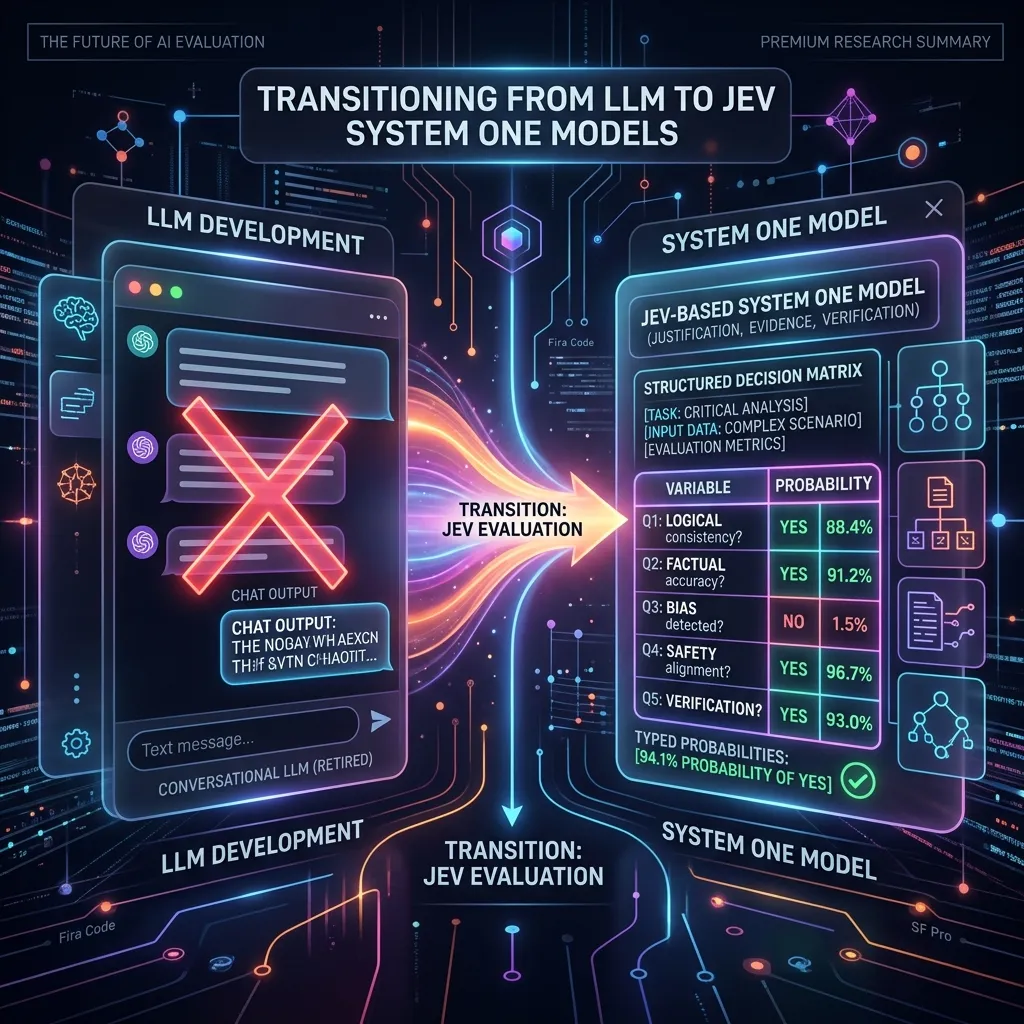
The man who taught ChatGPT to talk walked away and built a model that cannot say a single word. He spent years teaching machines to talk. One of the researchers behind reinforcement learning from human feedback (RLHF) at OpenAI helped turn a research model into ChatGPT, the default interface to AI for the entire planet. Then he left, disappeared into stealth for two years, raised $40 million, and came back with a frontier model that is physically incapable of generating text.
The Bet Underneath Jev
On September 15, 2026, his new company TypeSafe AI released Jev, a model that has no chat interface at all. It will not write code, compose emails, or explain its reasoning in prose. Instead, it returns typed decisions: a yes/no probability, a choice from a fixed list of options, or a score on a rubric, each accompanied by a calibrated confidence value between 0 and 1.
The bet underneath Jev is simple and ruthless: chat was the wrong target. A model built to talk is a fundamentally different thing from a model built to decide.
Why Now?
This model is landing at a very specific moment in the AI timeline. Agent frameworks are exploding. Every week brings a new stack for tool calling, browser automation, and multi-step workflows. Tool calling reliability is the bottleneck. The hardest part isn't generating ideas; it's picking the right tool, avoiding unsafe commands, and not crashing on malformed outputs.
Latency and cost have become frontier constraints. As models grow, each decision gets slower and more expensive, even when all you really need is a yes/no or an option choice. Calibration matters more than raw capability. In an automated pipeline, you don't just need answers, you need honest confidence numbers you can wire into thresholds and gates.
Jev is built exactly for this moment: a decision layer for agent ecosystems, designed to live inside workflows, not chat windows.
The Name is a Warning: Jevons Paradox for AI
Jev is named after economist William Stanley Jevons, who described a counterintuitive phenomenon in 1865: when James Watt made steam engines more efficient, Britain didn't burn less coal, it burned more. Efficiency drove the cost of coal down, demand exploded, and total consumption rose instead of falling.
TypeSafe chose Jev to make the same point about intelligence. As soon as judgment becomes cheap enough to ignore, it will be stuffed into every corner of software, infrastructure, and the web. System One models like Jev are designed to drive the cost of individual decisions so low that you can afford to have thousands of them running quietly inside your app, routing requests, scoring risk, and policing your other agents.
Inside the World's Fair Speech: Boom vs Bubble
Six weeks before Jev appeared, one of its creators stood on stage at the AI Engineer World's Fair and tried to explain why the industry felt split in half.
On one side is the boom camp: benchmarks crushed, reasoning chains stretching for thousands of tokens, models that can solve previously unsolved math problems. On the other side is the bubble camp, asking a simpler question: if AI is that omnipotent, why does every product still look like a chat box or a glorified terminal tool?
His dividing line was harsh. The tasks that look most impressive on paper all still have one hidden goal: pleasing the human in the loop. The stubborn business tasks that keep failing, like approvals, routing, refunds, risk decisions, have the opposite goal: removing the human from the loop entirely.
This is the real divide Jev is built to cross: assistance vs autonomous automation.
From RLHF to RLCD: Changing What Good Means
Most mainstream language models today are trained with RLHF or related recipes. The principle is straightforward: collect human ratings of responses, and optimize hard for those subjective preferences. Under that regime, good means producing text that human raters like. The model learns to hedge, ask for permission, apologize, and keep you in the loop.
TypeSafe's training method for Jev does something completely different. They call it Reinforcement Learning for Calibrated Decisions (RLCD).
- RLHF: trains a model to sound right to humans, even if its confidence is poorly calibrated.
- RLCD: trains a model to be right about its own confidence on structured decision tasks, even if it never writes a single token of prose.
Instead of optimizing for chat responses people prefer, RLCD optimizes for epistemically honest probabilities. When Jev says 0.9, it is supposed to be right about nine times out of ten on the decision type it was trained for.
Jev as a System One Model
TypeSafe describes Jev as the first public System One model, borrowing Daniel Kahneman's distinction between fast, intuitive System 1 thinking and slow, effortful System 2 reasoning.
Large language models are effectively System 2 engines: they generate answers token by token, stretching into long reasoning chains. Jev goes the opposite way: it does not generate text at all. It takes unstructured program state as input, and returns typed, probabilistic decisions in one parallel pass.
TypeSafe's own description is blunt: "think of Jev as a frontier intelligence function call: unstructured state in, typed probabilistic decisions out." Architecturally, Jev uses a parallel sampler rather than autoregressive token generation. Possible outputs are enumerated in advance in a schema.
The Three Primitives: Noul, Choice, Score
Jev answers only three kinds of questions, each with a confidence score:
- Noul - "Is this statement true?" Returns a calibrated probability between 0 and 1.
- Choice - "Pick one option from a fixed list." Up to 255 options, each with a probability.
- Score - "Place this situation on a scale." Returns a position on a rubric with a probability distribution.
Every answer arrives in a type your program already understands, and every answer carries its own uncertainty. Because the schema is fixed in advance, Jev is mathematically incapable of producing an output that violates the type system.
How Jev Actually Works in Your Stack
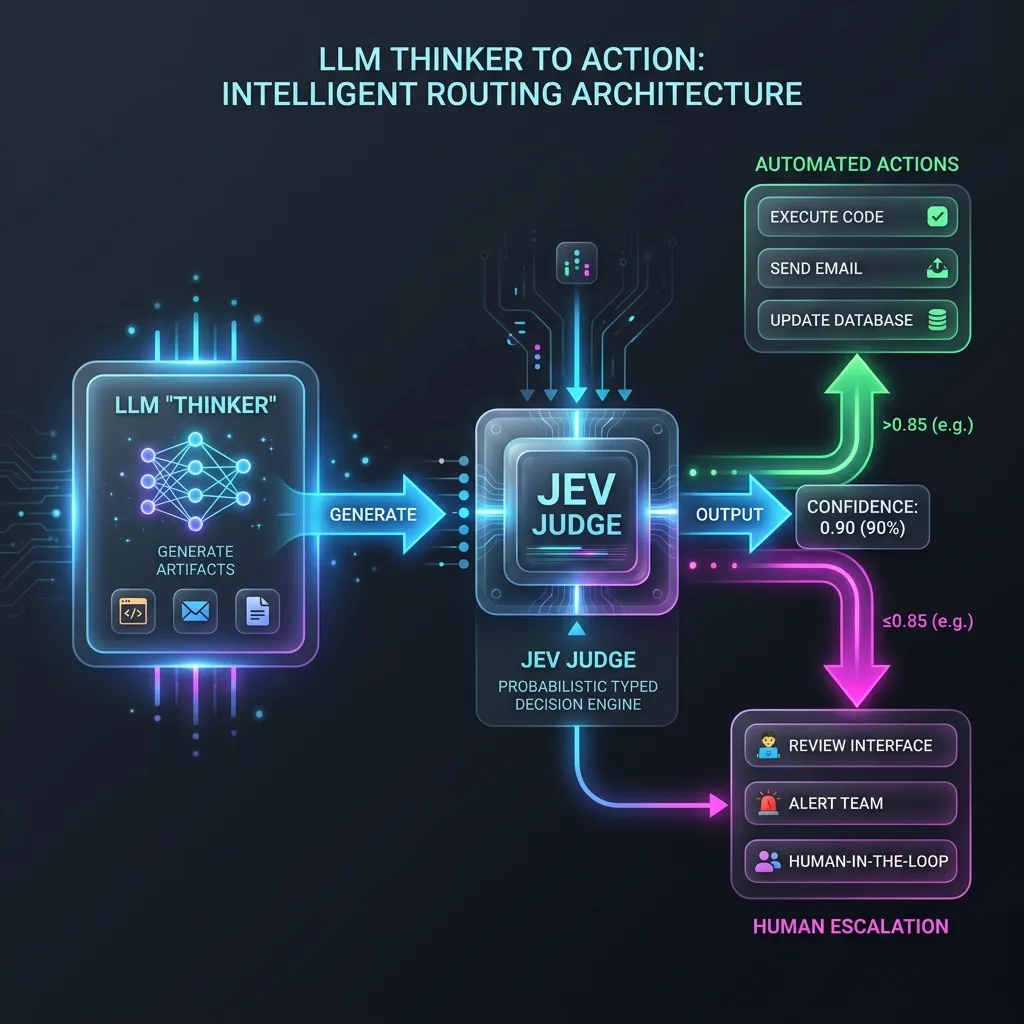
Jev punishes the reflex to treat every model as a chatbot. You don't talk to it. You wire it in as the judge in your pipeline, not the writer.
A typical architecture looks like this:
- Your LLM generates artifacts: Code, email drafts, summaries, step-by-step plans.
- Jev decides what to do with them: Classifies the request, scores the risk, picks routes, checks outputs.
- Your code controls the gates: Confidence thresholds decide whether to act, retry, escalate, or stop.
- Humans catch the edges: Difficult or risky cases stay in the loop, but routine decisions flow automatically.
You can wire your stack roughly like this: Above 0.9: act automatically. Between 0.6 and 0.9: retry or add more context. Below 0.6 on high stakes tasks: escalate to a human.
For more on building robust agentic frameworks, see our research on Production-Ready Agentic Workflows in 2026.
Real-World Use Cases
AI Agent Routing and Tool Selection: Most of what an AI agent asks a frontier model to do is choosing which tool to call next or whether a command is safe. Jev answers these in 70-500ms.
Customer Support Triage: Jev can simultaneously assign departments, score urgency, and decide if a human should intervene, without risking malformed JSON.
Safety Gates and Jailbreak Prevention: Jev's low cost makes it a perfect lightweight oversight layer to check if tool calls are safe.
Model Routing: Cheap tasks get routed to smaller models. Sensitive tasks get gated behind explicit approvals.
As discussed in our exploration of the Multi-Agent Office, having a dedicated routing layer is crucial for scaling automation.
Performance and Pricing: The Numbers
TypeSafe's launch materials show end-to-end latency at 70-500ms per call. Input pricing is $0.042 per million tokens, roughly 1/40 to 1/50 of GPT-Terra-class pricing. Output pricing is effectively free because there is no long text generation.
There are important caveats: most numbers are self-reported, calibration across domains is hard, and type-valid answers can still be confidently wrong. You can't just swap Jev in for a chatbot; you must re-architect flows.
What This Means for the AI Industry
Jev's launch points toward a broader re-architecture of AI products:
- Chat models become UI layers. Frontier LLMs handle conversation and explanation.
- Decision models become infrastructure. System One models like Jev live deep in the stack, enforcing typed contracts.
- Agent ecosystems bifurcate into thinkers and judges.
- The cost structure of AI products changes. Expensive frontier models get reserved for tasks only they can do.
For developers, the message is blunt: Stop using chat models for tasks that are really just smart if-statements. The man who taught ChatGPT to speak built a model that cannot say a word. That silence might be the loudest thing to happen in AI this year.
For more on building robust agentic frameworks, see our research on Production-Ready Agentic Workflows in 2026.
Read ArticleAs discussed in our exploration of the Multi-Agent Office, having a dedicated routing layer is crucial for scaling automation.
Read Article