The Enterprise AI Paradox: Why 94% of Companies Are Failing to See ROI

Artificial intelligence is everywhere in the modern workplace, yet a growing disconnect exists between the money companies pour into AI and the measurable value they get back.
The 6 Percent Reality
According to recent industry research, only about 6 percent of large enterprises have successfully moved AI projects from pilot to production in a way that meaningfully improves business outcomes. The other 94 percent are capturing some individual efficiency gains but failing to transform how their organizations actually work. This gap is one of the most important unsolved problems in technology today.
So why is enterprise AI stalling? The answer is not that the technology is weak. On the contrary, frontier models are more capable than ever. The real problem lies in three distinct layers that together form a system of friction. Until organizations address each layer, their AI investments will continue to underperform.
Layer One: The Model Capability Mismatch
Most large language models and foundation models are built by research teams whose primary focus is academic benchmarks. They optimize for math, reasoning, coding, and conversational fluency. These are valuable capabilities, but they are not the same as what enterprises actually need.
Enterprise work involves complex workflows, ambiguous policies, regulatory compliance, and domain specific knowledge that is rarely captured in public training data. Healthcare professionals need AI that understands medical coding and patient safety reporting. Financial institutions need systems that navigate compliance frameworks and risk assessments. Manufacturing companies need agents that integrate with supply chain data and quality control processes.
The teams that train frontier models have limited exposure to these real-world requirements. As a result, the models are brilliant at solving puzzles but struggle with the messy, context-dependent tasks that drive business value. This creates a fundamental goal gap. The models are optimized for the wrong things, and enterprises are left trying to force a square peg into a round hole.
Layer Two: The Integration Nightmare
Even if a model had perfect enterprise capabilities, getting it to work inside a large organization is a monumental challenge. Most enterprises have been accumulating technical debt for decades. Their systems are a patchwork of legacy databases, inconsistent APIs, and fragmented data formats.
During the digital transformation era, the intended consumer of all this fragmented information was a human. Humans are incredibly adaptable. They can read handwritten notes, interpret inconsistent PDFs, and piece together information from different sources. AI agents are not that flexible. They require clean, well-structured data, consistent schemas, and clear API specifications.
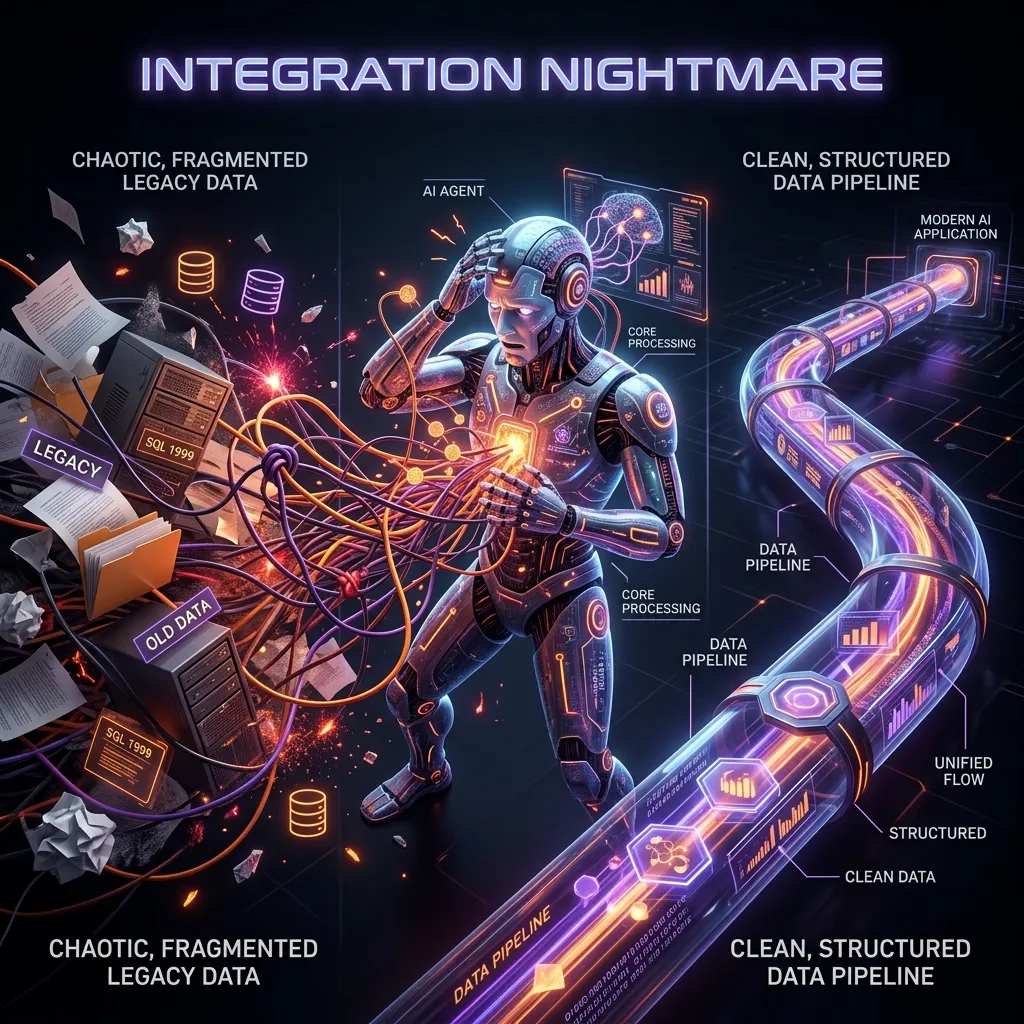
Consider a realistic example from the healthcare sector. Electronic medical records are supposed to follow a standard format, but in practice, patient histories often arrive as hundreds of pages of scanned PDFs from different providers. A human can read and synthesize that information. An AI system chokes on it. The same pattern appears in every industry. Customer records are scattered across multiple CRMs. Product data lives in disconnected spreadsheets. Process documentation exists in email threads and shared drives.
The friction of integration stops many AI projects dead in their tracks. Without a solid data foundation and interoperable systems, even the most advanced model cannot deliver reliable results.
Layer Three: The Organizational and Human Factor
This layer is the most overlooked and often the most damaging. AI adoption is not just a technology project. It is a change management initiative that touches every part of an organization.
A common failure pattern starts with leadership mandating the use of AI tools. Employees enthusiastically adopt them to boost their personal output. They write reports faster, respond to emails more quickly, and generate code with less effort. However, these individual gains rarely translate into organizational improvement.
Why? Because productivity improvements at the individual level simply shift the bottleneck elsewhere. If developers become 30 percent faster but the QA team stays the same, the overall delivery speed does not increase. If salespeople can draft proposals in half the time but the approval workflow remains unchanged, the sales cycle does not shorten.
Worse, the use of personal AI tools creates new problems. Proprietary information leaks through public interfaces. Institutional knowledge that should be shared across teams becomes trapped in private conversations with AI assistants. The organization loses the ability to capture and reuse the expertise that emerges from daily work.
Without intentional redesign of workflows, incentives, and collaboration patterns, AI adoption becomes a source of fragmentation rather than integration.
What the Successful 6 Percent Do Differently
The minority of companies that succeed with enterprise AI share three distinct characteristics. These are not accidental. They are deliberate choices that set them apart from the rest.
- Data Foundation First: They invest in their data foundation before anything else. They normalize schemas, resolve entity conflicts, and establish clear data governance.
- Change Management: Senior executives define clear success metrics and actively sponsor the transformation. They provide training and adjust organizational incentives to reward collaborative AI usage.
- Combining Expertise: They combine internal domain expertise with external AI specialization. When business process knowledge meets agent development best practices, the resulting solutions are technically sound and operationally relevant.
The Evaluation Problem That Nobody Talks About
One of the biggest technical hurdles in enterprise AI is evaluation. Traditional software development relies on unit tests with clear pass-fail criteria. AI systems are nondeterministic. They can produce different outputs for the same input, and they often express high confidence even when they are wrong.
To properly evaluate an AI system, you need to consider three dimensions:
- What is being evaluated (the entire system vs just the model).
- A comprehensive set of test cases (happy paths, edge cases, adversarial inputs).
- A robust method for judging output quality (accuracy, consistency, robustness, and calibration).
Furthermore, relying on human evaluation alone scales poorly. Enterprises need robust validation frameworks such as LLM-as-a-judge methods, programmatic semantic similarity scoring, and continuous testing frameworks like RAGAS for retrieval-augmented generation. Advanced teams run shadow deployments—running AI systems in parallel to human workflows without impacting actual business outcomes—to rigorously measure failure rates under live conditions.
Calibration is especially important. A well-calibrated system knows when it is uncertain and communicates that uncertainty clearly. Most current systems are overconfident, which makes human oversight difficult.
Humans Will Remain in the Loop, but Their Role Will Change
A common fear is that AI will eliminate the need for human workers. In enterprise settings, the reality is more nuanced. Humans will remain responsible for AI decisions because legal liability, regulatory compliance, and organizational accountability demand it.
However, the nature of human oversight will evolve. Initially, humans will need to validate high-stakes operations and triage ambiguous cases. As the system matures and trust builds, the human role shifts to higher-level supervision. People will focus on strategic direction, exception handling, and the creative judgment that AI cannot replicate.
A Practical Starting Point for Any Enterprise
If you are working inside a company that is struggling with AI adoption, the most important step is to choose the right pilot project. A successful pilot builds momentum and demonstrates value in a way that can be measured and communicated.
The right pilot must be truly valuable (aligned with business metrics), data-ready, and executable. Start with a narrow scope that gives you a path to success. Learn from that experience, refine your processes, and then expand to more ambitious use cases.
The Bottom Line
Enterprise AI is not failing because the technology is weak. It is failing because organizations treat it as a software purchase instead of a systemic transformation. The companies that succeed address the model capability gap, solve their integration challenges, and invest in organizational change.
More importantly, successful AI adoption relies on treating AI engineering with the same rigor as traditional software engineering. This means enforcing robust engineering practices: strong CI/CD pipelines customized for AI components, comprehensive observability and telemetry to catch drift in production, strict access controls, and reproducible data pipelines. Without this underlying engineering discipline, AI remains an experimental toy rather than an enterprise-grade solution.
The choice is not about whether AI will matter. It is about whether your organization will be ready when it does.