The Hidden Cost of Expense Ratios: A Decade of Compound Loss
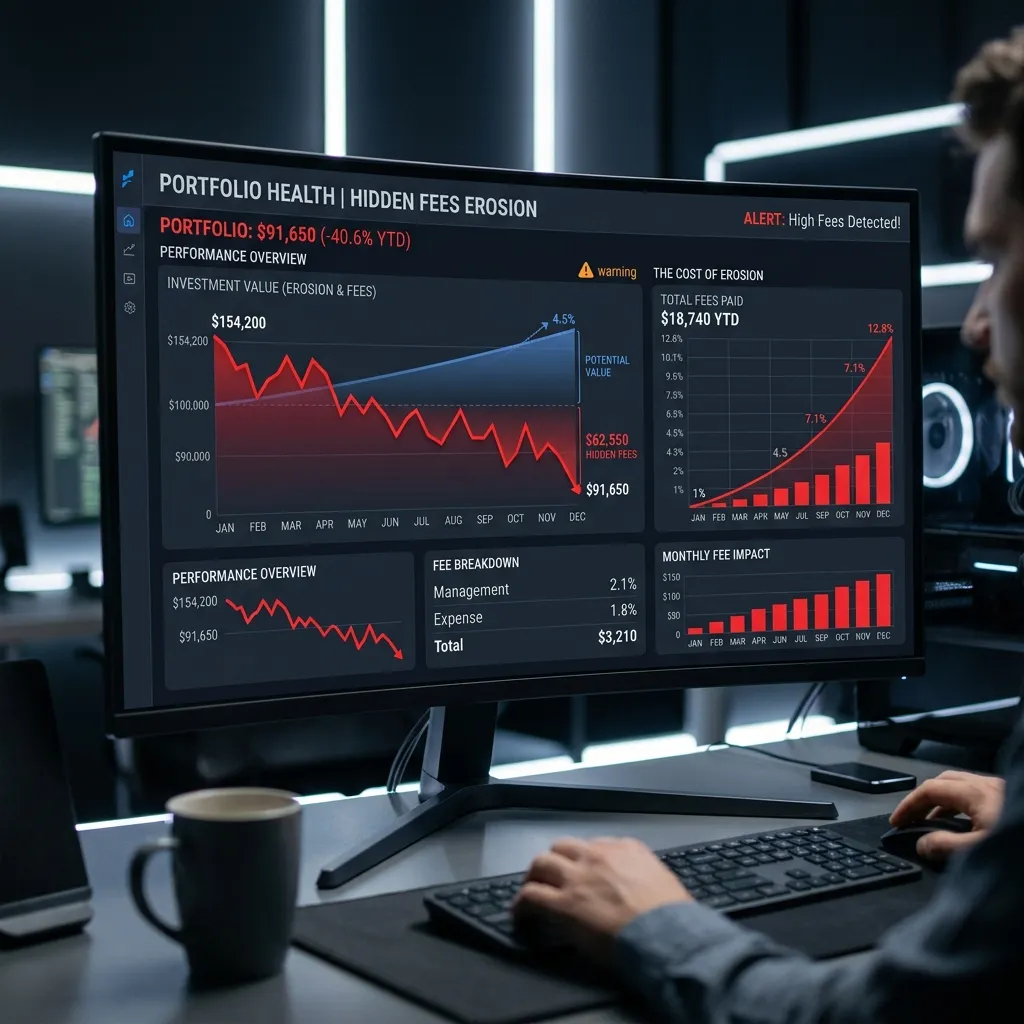
When evaluating investment options, a 1% management fee sounds negligible. If your portfolio returns 8% and your advisor takes 1%, you still keep 7%, right? While technically true for a single year, projecting this dynamic over a 30-year investing horizon reveals a devastating mathematical truth known as 'compound loss.' That 1% fee doesn't just cost you 1% of your final balanceâ€â€it can easily consume over a quarter of your potential wealth.
Step-by-Step Guide
- Log into your investment or 401(k) account and locate the 'Expense Ratio' or 'Fees' section for your current holdings.
- Compare these ratios against low-cost benchmark index funds (which typically charge 0.05% or less).
- Use an investment calculator to project how much your current fees will cost you over 20-30 years.
- If necessary, rebalance your portfolio into lower-cost funds that track the same underlying assets.
The Mechanics of Compound Loss
Albert Einstein famously called compound interest the 'eighth wonder of the world.' The concept is simple: your money earns interest, and in the next period, both your original money and the previous interest earn more interest. Over decades, this creates an exponential growth curve.
However, investment fees create a parasitic drag on this exact mechanism. When a fund charges an expense ratio, they deduct that money from your account balance regardless of market performance. That money is permanently gone. More importantly, you lose all the future compounding that money would have generated if it had remained invested.
A 30-Year Mathematical Example
Let's look at a concrete example. Suppose you invest $100,000 in a retirement account, add nothing further, and the market returns an average of 7% annually for 30 years.
- Scenario A (Low-Cost Index Fund): You pay a 0.05% expense ratio. Your net return is 6.95%. After 30 years, your portfolio grows to roughly $749,000.
- Scenario B (Actively Managed Fund): You pay a 1.5% expense ratio. Your net return is 5.5%. After 30 years, your portfolio grows to roughly $498,000.
The 1.5% fee didn't cost you 1.5% of the final balance. It cost you $251,000â€â€more than double your original investment, and exactly one-third of your potential wealth.
Expense Ratios vs. Advisor Fees (AUM)
Investors often face two distinct layers of fees:
1. Expense Ratios: Charged directly by the mutual fund or ETF to cover internal management and operating costs. You never write a check for this; it is silently deducted from the fund's net asset value (NAV).
2. Assets Under Management (AUM) Fees: Charged by financial advisors or wealth managers (commonly 1% to 1.5% per year) for designing the portfolio and providing financial advice. This is charged in addition to the underlying expense ratios of the funds they purchase for you.
If your advisor charges 1% and puts your money in mutual funds averaging 0.75%, your total fee burden is 1.75%. Over an investing lifetime, this nearly guarantees you will surrender half of your potential market returns to Wall Street.
The Rise of Vanguard and the Index Fund
The realization of this mathematical reality led Jack Bogle to found Vanguard and launch the first retail index fund in 1976. An index fund doesn't try to beat the market by hiring expensive analysts; it simply buys all the stocks in an index (like the S&P 500) and holds them. Because there is virtually no overhead, fees drop to near zero (often 0.03% to 0.05%).
Over long horizons, low-cost index funds consistently outperform actively managed funds, entirely due to the absence of the fee drag.
Frequently Asked Questions
What is an expense ratio?
An expense ratio is the annual fee charged by mutual funds and ETFs to cover management and administrative costs, expressed as a percentage of your investment.
Is a 1% expense ratio really that bad?
Yes. Over a 30-year investing horizon, a 1% fee can consume hundreds of thousands of dollars of your potential returns due to the loss of compounding interest.
How can I avoid high expense ratios?
Opt for passively managed index funds or ETFs, which often have expense ratios below 0.10%, rather than actively managed mutual funds.
Calculate exactly how much Wall Street is siphoning from your retirement using our Investment Fee Calculator.
Launch Tool