The Definitive AI Playbook for Enterprise Leaders: From Pilot to Production
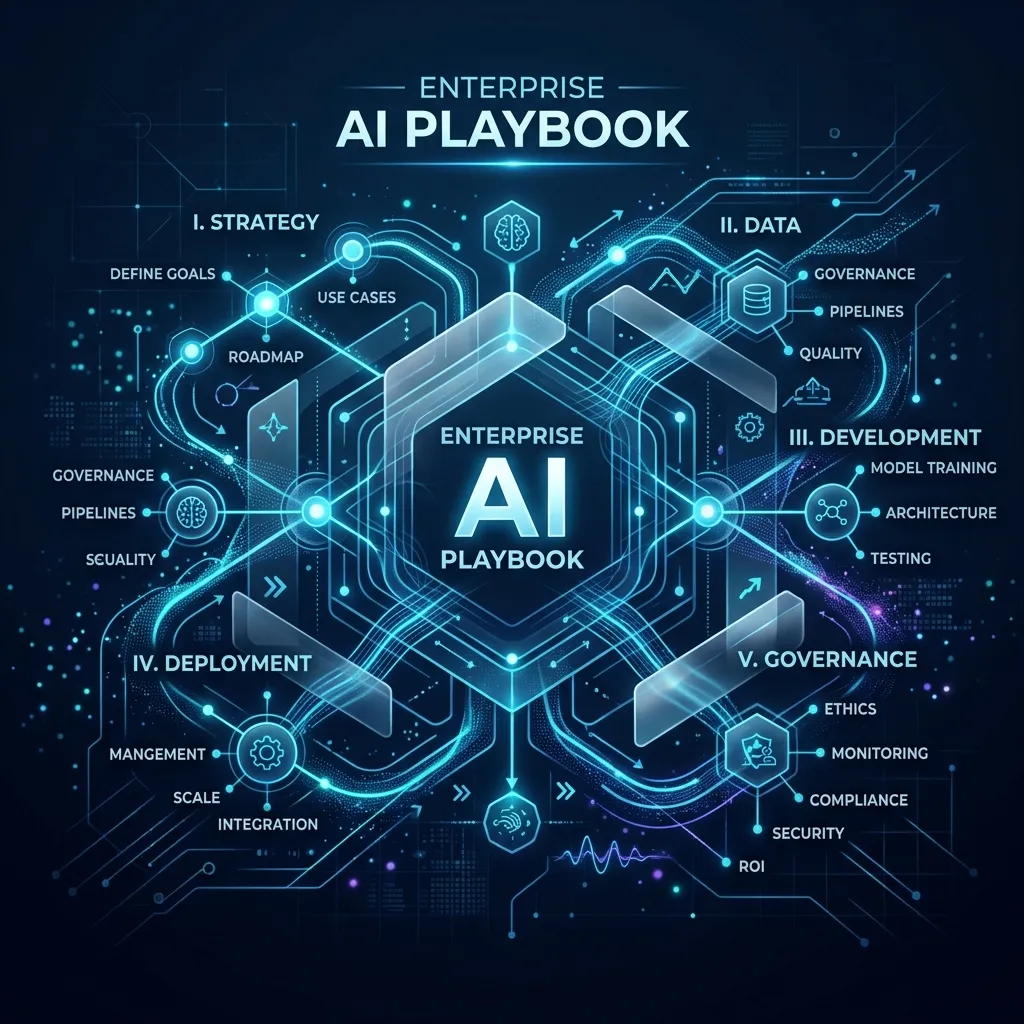
The numbers are sobering. Companies spent more than $150 billion on AI in 2025, yet only 6 percent of large enterprises have successfully moved AI projects from experimentation to production in ways that drive measurable business outcomes. The gap between investment and returns is growing, not shrinking. This is not a technology problem. It is a leadership problem. Most executives approach AI like any other software implementation. They buy a platform, assign a team, and expect results. What they get is a portfolio of impressive demos, scattered individual productivity gains, and a sinking feeling that they are falling behind competitors who seem to be moving faster. The difference between the 6 percent who succeed and the 94 percent who struggle is not budget, talent, or technology. It is approach. The winners treat AI as a strategic transformation that touches every part of the organization. The losers treat it as an IT project. This playbook is for leaders who want to be in the 6 percent. It covers the hard questions that most guides avoid: how to assess your actual readiness, how to manage the real risks, what metrics actually matter, how to structure your teams, and how to execute without losing momentum. Skip the fluff. This is the practical framework you need.
Part One: The Honest Pre-Mortem
Before you write a single line of code or sign a single contract, conduct a pre-mortem. Gather your leadership team and imagine that your AI initiative has failed spectacularly one year from now. What went wrong? Most pre-mortems surface the same three issues.
Data quality. Your AI system will only be as good as the data it consumes. If your customer records are inconsistent across systems, if your product catalogs are incomplete, if your transaction history is fragmented across legacy databases, AI will amplify these problems, not solve them. You cannot sprinkle intelligence on top of garbage. Ask yourself: Do you have a single source of truth for your critical business data? Can you trace any piece of information back to its authoritative source? Do you have clear ownership for data quality? If the answer to any of these questions is no, your first investment should be in data infrastructure, not AI models.
Organizational friction. AI changes how work gets done. It automates tasks that people used to do manually. It surfaces insights that challenge existing assumptions. It requires new skills and new workflows. Without intentional change management, employees will resist, circumvent, or sabotage the new systems. Ask yourself: Do you have champions in each business unit who will advocate for the new ways of working? Have you communicated clearly about what AI means for job roles and career paths? Are your performance incentives aligned with collaborative AI usage rather than individual productivity hacks? If you are not ready for organizational change, your AI investment will not deliver returns.
Technical debt. Most large enterprises have accumulated decades of technical debt. Systems that were state-of-the-art twenty years ago are now brittle, poorly documented, and difficult to integrate. AI adds another layer of complexity on top of this shaky foundation. Ask yourself: How well documented are your existing APIs and data schemas? How long would it take to connect a new application to your core systems? Do you have the engineering capacity to modernize where needed? If your technical foundations are weak, AI will expose every crack.
Part Two: The Risk Assessment Framework
AI introduces risks that traditional software projects do not face. Leaders need a systematic framework for identifying, evaluating, and mitigating these risks.
Data Privacy and Security
When employees use public AI tools, they may inadvertently expose proprietary information. Customer data, financial projections, strategic plans, and source code have all been leaked through casual use of consumer-grade AI. Build clear policies that specify what can and cannot be shared with external AI services. For sensitive workloads, consider deploying private models that run within your own infrastructure. Work with your legal and compliance teams to understand regulatory requirements in your industry. Healthcare organizations must comply with HIPAA. Financial institutions face SEC and FINRA regulations. European companies must navigate GDPR.
Model Reliability
AI systems make mistakes. They hallucinate facts, misinterpret context, and sometimes produce confident but incorrect outputs. These errors can be harmless in some contexts and catastrophic in others. Build processes to catch errors before they reach customers or decision makers. Start with low-stakes applications where mistakes are easily caught and corrected.
Vendor Lock-In
Many AI platforms use proprietary APIs and data formats that make it difficult to switch providers. If you build your entire application around a single vendor's API, you may find yourself trapped when prices rise, capabilities decline, or the vendor changes its roadmap. Design your architecture to be modular. Use abstraction layers that allow you to swap out underlying models without rewriting your entire application. Open-source models like Llama, Mistral, and others provide competitive capabilities without vendor lock-in. Consider a multi-vendor strategy.
Human Oversight Requirements
Determine which decisions require human review and which can be fully automated. Document escalation paths so that everyone knows who is responsible when something goes wrong. Create audit trails that let you trace every decision back to its source.
Part Three: The Developer Practice Stack
Your engineering team needs specific capabilities and support to succeed with AI. These are different from traditional software development skills. Build your practice stack around four pillars.
Evaluation Infrastructure: Traditional unit tests do not work for AI systems because outputs are nondeterministic. Build a test harness that can run large evaluation suites automatically. Include tests for accuracy, consistency, robustness, and calibration. Run these evaluations continuously as you update models, change prompts, or add new data.
Prompt Engineering and Context Management: The difference between a mediocre AI application and an excellent one often comes down to how you structure prompts and manage context. Create internal best practices for prompt design. Pay special attention to context management. Experiment with techniques like retrieval augmented generation, where the system searches for relevant documents before generating a response.
Monitoring and Observability: AI applications can degrade over time as data distributions shift and models are updated. Implement logging that captures inputs, outputs, and performance metrics for every transaction. Set up alerts for unusual patterns like increased error rates, slower response times, or unexpected output distributions. Monitor user feedback as well as technical metrics.
Training and Skill Development: AI development requires new skills and new mental models. Invest in internal workshops that cover these topics. Consider building a center of excellence that maintains best practices, provides support to project teams, and stays current with the rapidly evolving AI landscape.
Part Four: The ROI and Metrics Framework
One reason AI projects fail is that success is never clearly defined. Leaders need to establish concrete ROI checkpoints and success metrics before starting any major initiative.
Start with the Business Problem, Not the Technology
What specific pain point are you trying to address? What metric will improve if you succeed? A good AI project reduces costs, increases revenue, or improves customer satisfaction in measurable ways. Define your baseline before you start. How long does a task take today? How much does it cost? What is the error rate? Without a baseline, you cannot measure improvement.
Build Milestone-Based Checkpoints
Divide your project into phases, each with its own success criteria. Phase one might be a proof of concept that runs on sample data. Phase two might be a pilot with real users in a controlled environment. Phase three might be production deployment with limited scope. Each phase should have clear go-no-go criteria.
Measure Both Technical and Business Metrics
Technical metrics include accuracy, latency, cost per inference, and system uptime. Business metrics include the actual outcomes you care about: reduced processing time, increased conversion rates, lower support costs. Track both and look for correlation. If technical metrics are improving but business metrics are not, you may be optimizing the wrong thing.
Plan for Continuous Improvement
AI systems improve over time as you collect more feedback and fine-tune models. Build mechanisms for gathering user feedback, monitoring performance, and iterating on your approach. Allocate budget and resources for ongoing maintenance and improvement, not just initial development.
Part Five: The Execution Playbook
Here is a practical sequence for rolling out AI in your organization. It is designed to minimize risk while building momentum and organizational confidence.
Start with a Single Pilot: Choose a use case that is narrow in scope but meaningful in impact. Look for a task that is time-consuming, repetitive, and well-defined. Treat the pilot as a learning exercise, not a final product.
Use Existing Infrastructure Where Possible: Cloud providers offer managed AI services that handle many integration and scaling challenges. Start with these proven options before building custom solutions.
Partner with External Specialists: AI development requires specialized knowledge that few internal teams have. Choose partners who complement your internal capabilities rather than replacing them. Look for partners who are willing to transfer knowledge and build your internal skills.
Involve End Users Early and Often: AI applications are only useful if people actually use them. Design workflows that integrate with existing tools and habits. Celebrate early wins to build momentum and enthusiasm.
Create a Governance Structure: Establish an internal AI review board that includes representatives from engineering, legal, compliance, and business units. Clear governance prevents fragmentation and inconsistency.
Part Six: The Human Side of AI Adoption
Technology is only half the story. The other half is how people adapt to new ways of working. Leaders who ignore the human dimension undermine their own investments.
Communicate Honestly: Be open about why you are pursuing AI and what it means for employees. People worry about job security when automation is introduced. Address these concerns directly. Emphasize that the goal is to make work more productive and meaningful, not to replace people.
Redesign Workflows Around Collaboration: Most AI performs best as a copilot, not an autopilot. Identify which tasks can be fully automated and which require human judgment. Design interfaces that make collaboration natural and efficient.
Reward the Right Behaviors: Many organizations accidentally incentivize individual AI usage that fragments knowledge and creates silos. Instead, reward employees who share effective practices, document successful prompts, and contribute to the organization's collective AI capability.
Invest in Training at Every Level: Leaders need to understand what AI can and cannot do. Managers need to support their teams through the transition. Individual contributors need hands-on skills. Create a comprehensive training program that addresses each of these needs.
Part Seven: Avoiding the Most Common Pitfalls
Learn from the mistakes of others. These are the most common reasons that AI projects fail.
- Pitfall One: Starting with Technology, Not the Problem. Many teams choose a cool technology and then search for a problem to apply it to. Start with the business problem and then find the right technology to solve it.
- Pitfall Two: Underinvesting in Data. AI is only as good as the data it consumes. Skimping on data quality is a false economy. Invest in data infrastructure before you invest in AI applications.
- Pitfall Three: Ignoring Integration Complexity. Getting an AI system to work inside an enterprise is harder than building the AI itself. Plan for integration costs that are at least equal to development costs.
- Pitfall Four: Launching and Leaving. AI systems require continuous improvement. Treat deployment as the beginning, not the end. Allocate resources for ongoing maintenance and enhancement.
- Pitfall Five: Neglecting Change Management. Technology adoption is a people problem, not a technology problem. Invest in change management commensurate with the scale of change you are introducing.
The Bottom Line for Leaders
AI is not a silver bullet. It is a powerful technology that requires disciplined execution. The companies that succeed invest in foundations, manage risks systematically, build capable teams, measure progress rigorously, and manage the human side of change.
The 6 percent who are winning today are not lucky. They are intentional. They treat AI as a strategic priority that deserves sustained attention and investment. They resist the temptation to chase shiny demos and focus instead on building durable capabilities.
You have a choice. You can follow the herd, spend money on AI pilots, and wonder why they do not deliver results. Or you can take a deliberate approach that addresses the real barriers to success. The gap between AI spending and AI value will not close by itself. It takes leadership to close it.
Your organization is probably not ready for AI at scale. That is okay. No one is ready without doing the work. The question is whether you are willing to do the work, build the foundations, and lead your organization through the transformation. The winners are already starting. What are you waiting for?